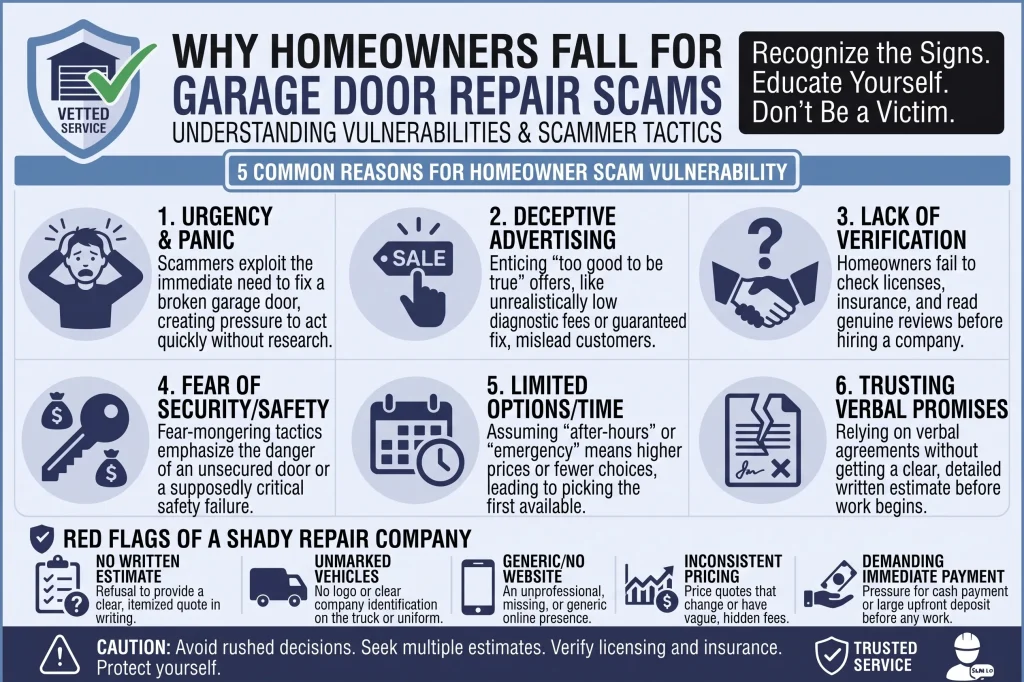
Urgency, unfamiliarity with spring and cable pricing, and convincing sales tactics explain why homeowners fall for garage door repair scams more often than you might think. A rushed installation or repair skips the basic checks that would otherwise expose a bad actor in the garage door industry.
Recognizing these tactics in advance turns a stressful, time-pressured decision into a manageable one with room for real verification. This guide breaks down common garage door repair scams, the warning signs that expose them early, and the practical steps that keep every service call safe from start to finish.
Key Takeaways
- Emergencies push homeowners toward the first technician instead of a vetted one
- Recognizable scam categories share patterns across the garage door industry
- Warning signs often appear before a technician inspects the spring, track, or opener
- Psychological triggers like urgency and fear explain why repair scams succeed
- Fast, documented action after a scam limits damage and supports a later dispute
- Verifying company credentials before scheduling prevents most scams entirely
Common Types of Garage Door Repair Scams
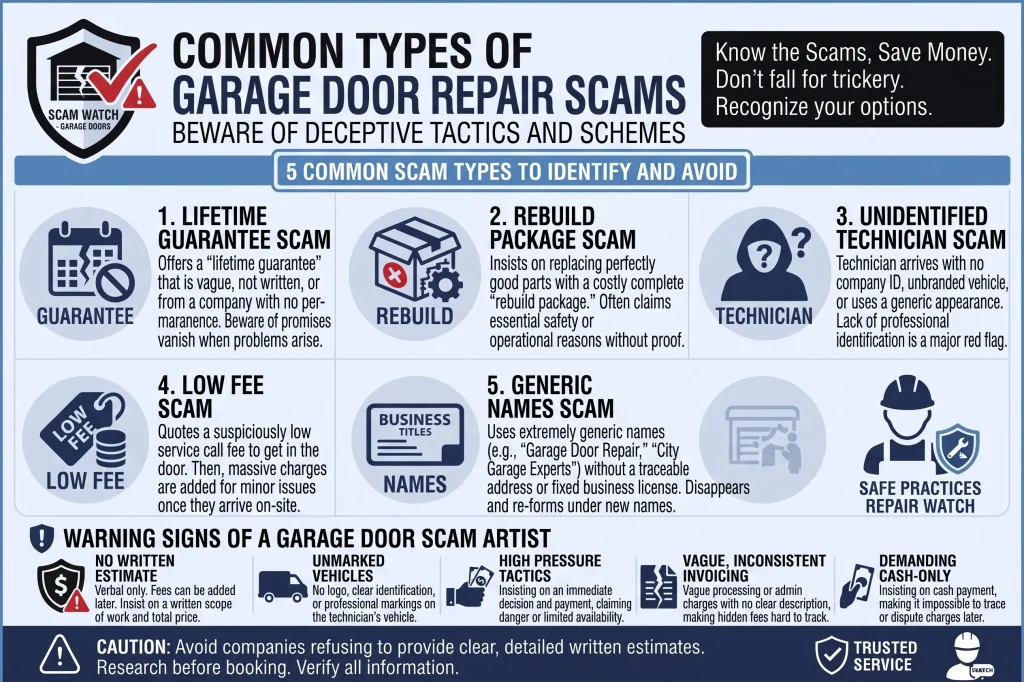
Garage door repair scams tend to follow recognizable patterns, each built around a different way to inflate the final repair cost.
Scam Type | How It Works | What It Targets |
Lifetime guarantee scam | Sells inflated warranty coverage on springs unlikely to fail | Homeowners seeking long-term peace of mind |
Rebuild package scam | Bundles unrelated parts into a forced overhaul with no real wear behind it | Homeowners unfamiliar with actual repair scope |
Unidentified technician scam | Sends unmarked vehicles with no visible identification | Homeowners who skip ID checks at the door |
Low fee scam | Adds hidden charges once the technician inspects the opener | Homeowners comparing prices before booking |
Generic names scam | Operates under a name with no verifiable local history | Homeowners searching quickly for nearby help |
To understand each of these common scam tactics in much greater depth, read our guide on What Are Common Garage Door Repair Scam Tactics?, which breaks down the exact warning signs tied to every category listed above.
Warning Signs of a Garage Door Repair Scam
A scam usually surfaces before a technician ever inspects the springs, cables, or opener, often in the advertisement or the first phone call.
Red flags worth noticing well before scheduling include:
- A phone number that forwards to a different area code than advertised
- No legitimate physical showroom listed anywhere on the company website
- Photos reused across several unrelated garage door dealers
- Reviews that read as generic praise without naming a specific repair
- Pressure to book same-day emergency service before pricing is discussed
To review the exact wording and pricing patterns found in a scam advertisement, read our guide on How to Tell If a Garage Door Repair Ad Is a Scam, which walks through each red flag before a technician is ever contacted.
The Psychology Behind Falling for a Repair Scam
Urgent Desperation
An emergency garage door repair creates an immediate safety concern when a broken spring or snapped cable traps a vehicle inside or leaves a home unsecured.
The urgency shows up in predictable ways:
- Calling the first phone number found in a rushed online search
- Bypassing a check of reviews or company credentials before scheduling
- Accepting a same-day appointment without asking about service costs
- Feeling relieved rather than cautious when someone answers quickly
- Assuming any technician can safely handle a torsion spring under tension
Pausing even briefly during an emergency repair service restores enough clarity to ask basic verification questions before a technician touches the door.
Mechanical Ignorance
Few homeowners carry a working sense of what a torsion spring, cable, or opener motor replacement should reasonably cost before a technician arrives.
Signs of this gap being exploited include:
- Accepting a quoted price without asking what specific repair the total actually covers
- Believing technical-sounding language about cable tension automatically means the diagnosis is accurate
- Assuming a repair company would never exaggerate damage to a roller or track
- Failing to request a detailed estimate before authorizing repair work
- Trusting a verbal explanation over a written estimate naming the exact repair
Asking a technician to explain the specific spring or cable failure in plain language often exposes whether the diagnosis holds up to scrutiny.
Trust in Familiar-Sounding Local Listings
Scam operations frequently register business names that sound like an established local garage door dealer, complete with generic branding and a local phone number.
The deception typically relies on these signals:
- A business name nearly identical to a real, established local competitor
- Stock photography of springs and openers instead of real trucks, staff, or completed jobs
- A website with no verifiable years in business or local history
- Search ads that list a service area without a real office location
- Reviews concentrated in a short time window rather than spread over years
Checking a company name alongside its listed address on Google Maps quickly confirms whether the business operates from where it claims.
High-Pressure Tactics on the Spot
Manufacturing urgency once inside the home relies on a homeowner feeling unable to question a claimed hazard involving a spring, cable, or panel.
These tactics tend to follow a familiar script:
- Claiming a torsion spring could snap catastrophically within hours or days
- Refusing to leave a written quote for the homeowner to review later
- Discouraging a call to another company for comparison
- Demanding a decision before finishing the stated inspection
- Framing hesitation as a decision that increases personal risk
Stepping outside the home to call for one of several trusted second opinions often eases this kind of on-site pressure considerably.
Fear of a Bigger, Costlier Problem
Add-on repairs, from a new garage door opener to a full replacement panel swap, often get framed as prevention against a future failure that hasn’t happened yet.
The fear tactic commonly includes these patterns:
- Warning that a working spring or cable will fail soon without proof of wear
- Bundling several repairs together as a single required package
- Using vague language about structural risk without naming a specific defect
- Suggesting a full door replacement instead of addressing the actual complaint
- Framing hesitation as a choice that raises the eventual repair cost
Following a trusted protect-and-respond framework helps a homeowner confirm whether a claimed repair need is real before approving any add-on work.
What to Do After Being a Victim of a Garage Door Repair Scam
Financial damage stays limited only when a homeowner documents everything and moves quickly after suspecting a scam on a recent spring or opener repair.
Recovering from a bad experience starts with these actions:
- Requesting a full, written invoice naming every repair performed and its cost
- Disputing the charge directly with the credit card issuer
- Photographing all replaced garage door springs, cables, or panels before the technician leaves
- Searching the company name alongside recent complaints from other homeowners
- Contacting a licensed garage door repair specialist for a second opinion
Local authorities and a licensing board can only act on a scam when the complaint names the specific overcharges and parts involved.
How to Prevent Falling for a Repair Scam
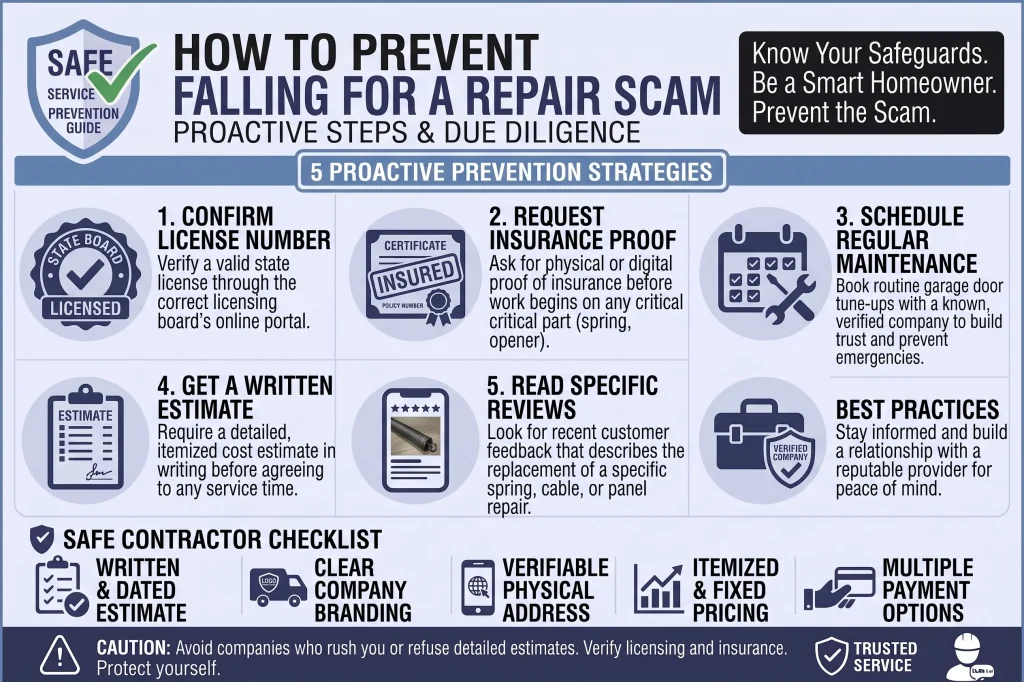
Only a few extra minutes of research separate a homeowner from most of the risk tied to an unfamiliar garage door service company.
Consistent prevention comes down to these habits:
- Confirming a valid license number through the correct state licensing board
- Requesting proof of insurance before any technician touches a spring or opener
- Scheduling garage door maintenance with a known, verified company on a regular basis
- Getting a written estimate before agreeing to a specific date or time
- Reading reviews that describe a specific spring, cable, or panel repair rather than vague praise
To walk through the full process of confirming a company before hiring, read our guide on How to Find a Trustworthy Garage Door Repair Company, which outlines exactly what to verify before the first appointment.
A Careful Homeowner Beats a Convincing Scam Every Time
Urgency, unfamiliarity with spring and cable pricing, and on-site pressure have to combine before a garage door repair scam can override a homeowner’s better judgment. Verifying a company before any work begins protects both the wallet and the safety of everyone who relies on the door daily.
Garage Doors Guaranteed works with homeowners across Melbourne, FL to diagnose real spring, cable, and opener problems honestly before any work begins. Contact us or give us a call today, and let our team confirm exactly what the repair requires before approving a single charge.