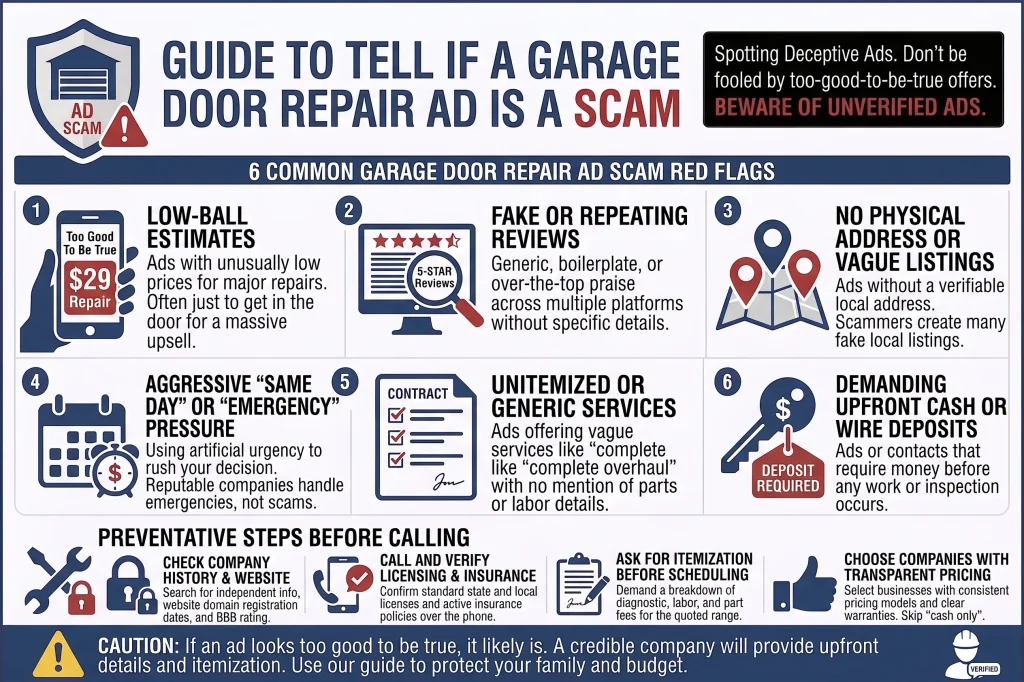
An honest garage door repair ad names a real business, a real price range, and a real service area without vague language standing in for facts. A scam ad typically hides at least one of these details behind generic branding, an unrealistic price, or reviews that read the same across several unrelated companies.
Checking an ad against a short list of details takes less time than a single phone call and prevents most bad hires before they start. This guide breaks down the specific signs that separate a legitimate ad from a scam, both in the listing itself and once a technician arrives at the door.
Key Takeaways
- A legitimate ad names a real business with a verifiable address and license
- Scam ads often advertise a price far below the average cost for the same repair
- Duplicate or generic reviews across multiple listings signal a fake business presence
- Unmarked vehicles and missing identification are warning signs that appear in person
- Cash-only demands and refused card payments are common closing-stage red flags
Legitimate Ads vs Scam Ads at a Glance
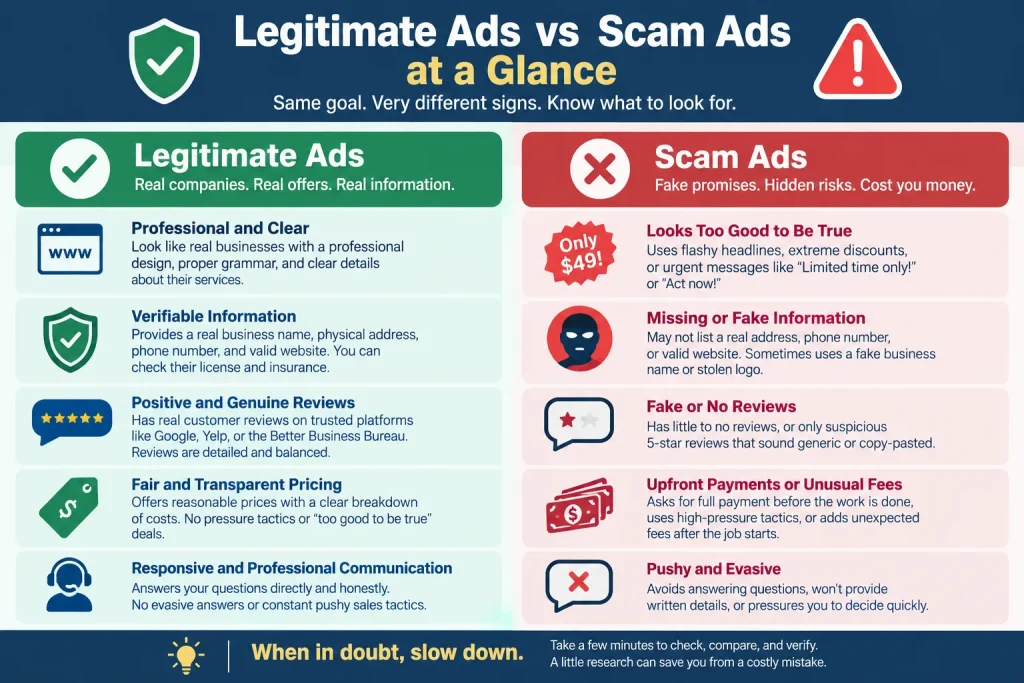
A scam operation has no real business behind the advertisement, which is why so many of its advertised details fall apart under basic scrutiny.
Ad Element | Legitimate Ad | Scam Ad |
Business name | Matches state licensing records exactly | Slightly altered or generic across listings |
Address | A real, verifiable physical business address | Missing, vague, or a residential lot |
Pricing | A realistic range tied to the actual repair | An unrealistically low flat fee |
Reviews | Varied, specific, spread across time | Repetitive, generic, or duplicated |
Photos | Real trucks, staff, and completed jobs | Stock imagery reused across sites |
Licensing records take only a few minutes to check and settle most doubts about a business faster than any other single verification step.
Red Flags in Ads and Online Listings
Generic Names
A business advertising under multiple, slightly different names is rarely registered as a single, accountable legitimate business.
This pattern tends to surface through:
- A business name that shifts slightly between the ad and the invoice
- No matching entry in state or local licensing records
- Multiple ads for the same phone number under different company names
- A name designed to sound like a well-known local competitor
- No mention of how long the business has operated under that name
Searching the business name and phone number together usually exposes every garage door installation or repair company using that same identity.
No Real Address
An ad that skips a physical business address entirely, or lists one that turns out to be a residential lot, is hiding something worth questioning.
An address problem typically looks like:
- No address listed anywhere on the website or ad itself
- An address that maps to a vacant lot or private residence
- A legitimate physical showroom claimed but never confirmed
- Refusal to provide an address when asked directly by phone
- A service area listed without any single fixed office location
Checking the address on Google Maps before scheduling service, like garage door maintenance, confirms whether the business operates from where it claims.
Suspicious Reviews
Reviews that repeat the same phrasing across several unrelated company pages rarely reflect real customer experiences.
Manufactured reviews tend to share these traits:
- Nearly identical wording appearing across multiple business listings
- Reviews posted in a short burst rather than spread over months or years
- Vague praise with no mention of a specific repair, spring, or opener
- Five-star ratings with no written detail backing up the score
- Reviewer profiles with no other activity anywhere else online
Recognizing manufactured reviews protects against the same pricing pressure that a fake five-star rating often supports.
Bait-and-Switch Pricing
A flat low service call fee advertised with no clear mention of what the total repair actually covers almost never reflects the real price.
The advertised price usually comes with:
- A price advertised well below the average cost for the same repair
- No mention of what specific repair the advertised price actually covers
- Fine print excluding common repairs from the advertised rate
- No mention of what happens if the diagnosis differs from the quote
- Pressure language urging same-day booking to lock in the price
To understand how this pricing structure connects to the psychology behind it, read our guide on Why Do Homeowners Fall for Garage Door Repair Scams?, which explains why a low number works so well.
Warning Signs When They Arrive
Unmarked Vehicles
A technician arriving in a plain van or personal vehicle with no visible branding contradicts whatever company name appeared in the ad.
A mismatched vehicle usually reveals:
- No company logo, name, or contact information on the vehicle
- A personal car or unmarked rental van used instead of a branded truck
- Mismatched vehicle branding compared to the original ad or website
- Reluctance to explain why the vehicle carries no company markings
- A different business name mentioned in person than the one advertised
Photographing the vehicle before the technician leaves gives a homeowner useful evidence if the business name later turns out to be fabricated.
No Uniform or ID
Missing identification of any kind makes it genuinely difficult to confirm who is actually completing the repair inside a home.
Missing identification tends to look like:
- No employee badge, ID card, or company uniform worn on-site
- Inability to produce company credentials when asked directly
- A refusal to confirm employment status with the company’s main line
- No visible license number displayed on paperwork or a vehicle
- Vague or inconsistent answers about training or certification
Calling the company directly through the protect-and-respond framework recommended by industry safety groups confirms employment status within minutes.
High-Pressure Tactics
Claims that a spring, drum, or motor is unsafe and requires immediate replacement often serve the sales pitch more than the actual diagnosis.
The pressure typically builds through:
- Warning that a part could fail catastrophically within hours
- Refusing to leave a written quote for later comparison
- Discouraging a call to another company for a second opinion
- Demanding an answer before finishing the stated inspection
- Framing hesitation as a choice that raises personal risk
To connect this on-site pressure tactic to the full pattern of tactics scammers rely on, read our guide on What Are Common Garage Door Repair Scam Tactics?, which breaks down exactly how each one is designed to work.
Demanding Cash Upfront
Refusing a traceable credit card and demanding full cash payment before confirming any work removes a homeowner’s ability to dispute the charge later.
This kind of demand often includes:
- Refusing card payments in favor of cash or untraceable methods
- Requesting full payment before starting any hands-on repair, such as garage door spring replacement or a full opener swap
- No willingness to accept payment only after the job is finished
- No receipt or itemized invoice offered after payment is collected
- Pressure to pay quickly before fully explaining the completed work
Insisting on a card payment and a written, itemized receipt keeps a clear paper trail if you ever need to formally dispute the charge later.
What to Do After Noticing a Suspicious Ad
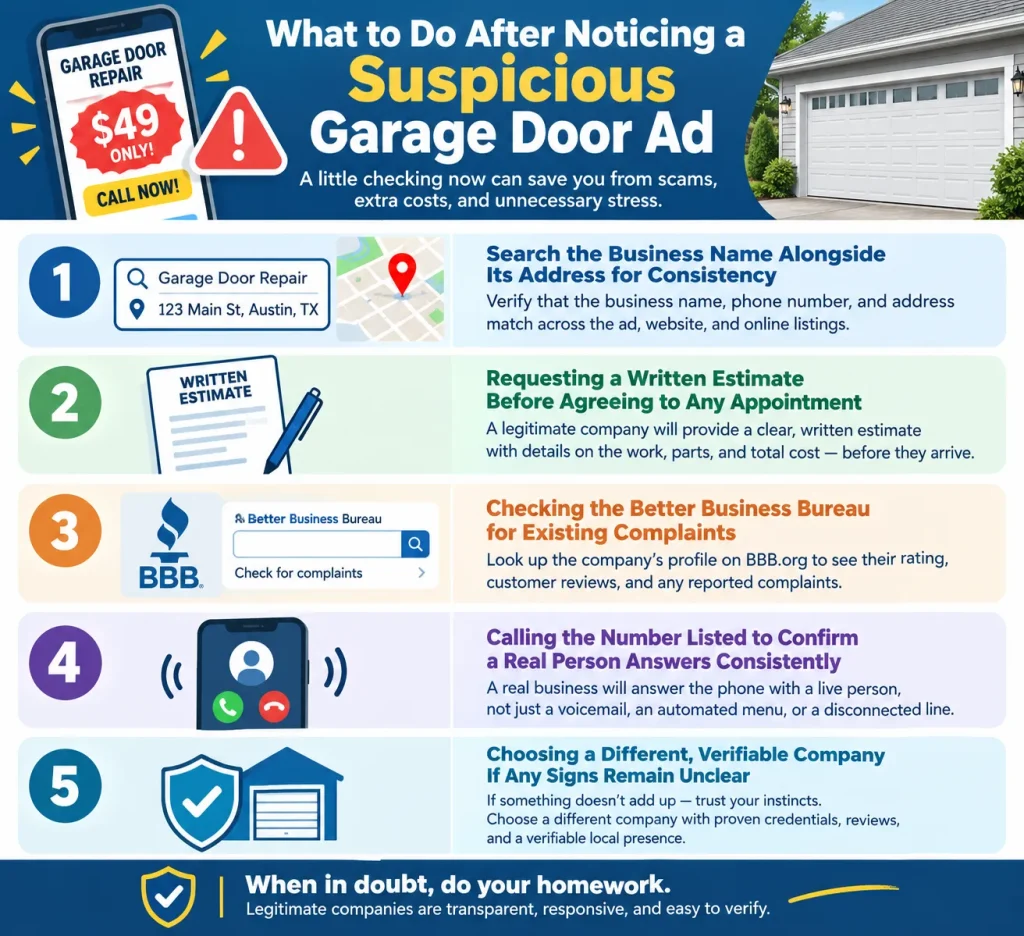
Responding to these signs before making the call helps prevent most of the financial risk described throughout this guide.
The safest response to a suspicious ad includes:
- Searching the business name alongside its address for consistency
- Requesting a written estimate before agreeing to any appointment
- Checking the Better Business Bureau for existing complaints
- Calling the number listed to confirm a real person answers consistently
- Choosing a different, verifiable company if any signs remain unclear
To walk through the complete process of confirming a company’s legitimacy before hiring, read our guide on How to Find a Trustworthy Garage Door Repair Company, which outlines exactly what to verify before scheduling the first appointment.
The Details Missing From an Ad Say the Most
A scam ad relies on vague, generic details to stand in for facts a homeowner can verify in seconds with a quick search or phone call. Sharing a specific detail without ever being asked is usually a strong sign of a business with nothing meaningful left to hide from the very start.
Garage Doors Guaranteed advertises real pricing, a real service area, and real, licensed technicians to homeowners across Melbourne, FL every single day of the week. Contact us or give us a call today, and let our team answer any question a genuinely honest ad should never need to avoid or dodge.